
What actually works for Wellington windows.
After twenty years measuring houses from Island Bay to Waikanae, a few patterns hold. Here's what we tell people when they ask what to put on their windows.
Older villas: thin joinery, tall windows, cold rooms
Most of the villa and bungalow stock through Newtown, Berhampore, Mount Victoria and Petone was built with single-glazed timber joinery. The frames are beautiful and worth keeping — but the glass is a heat sink. If you're picking one product to warm the room up, honeycomb (cellular) blinds sit closer to the glass than a curtain and trap air in the cell. In a typical villa bedroom we'd usually spec a blockout honeycomb with side channels for a genuine thermal seal.
If you're also chasing the traditional look, layer a lightweight sheer curtain over the honeycomb. It hides the blind by day and gives the room the softness the joinery deserves.
Bay windows: don't fight the shape
The three-panel bay in a Wellington villa is the trap. You can force one continuous curtain track around it, but you'll spend forever wrestling with the stack-back in the corners. What actually works is individual roller or honeycomb blinds inside each face of the bay, then a simple pinch-pleat curtain across the front of the bay for evening privacy and warmth.
For heritage front rooms where blinds would look wrong, plantation shutters framed into each face of the bay give you the historical feel plus real light control. We build these in three separate frames so each panel operates independently.
Skylights and angled tops
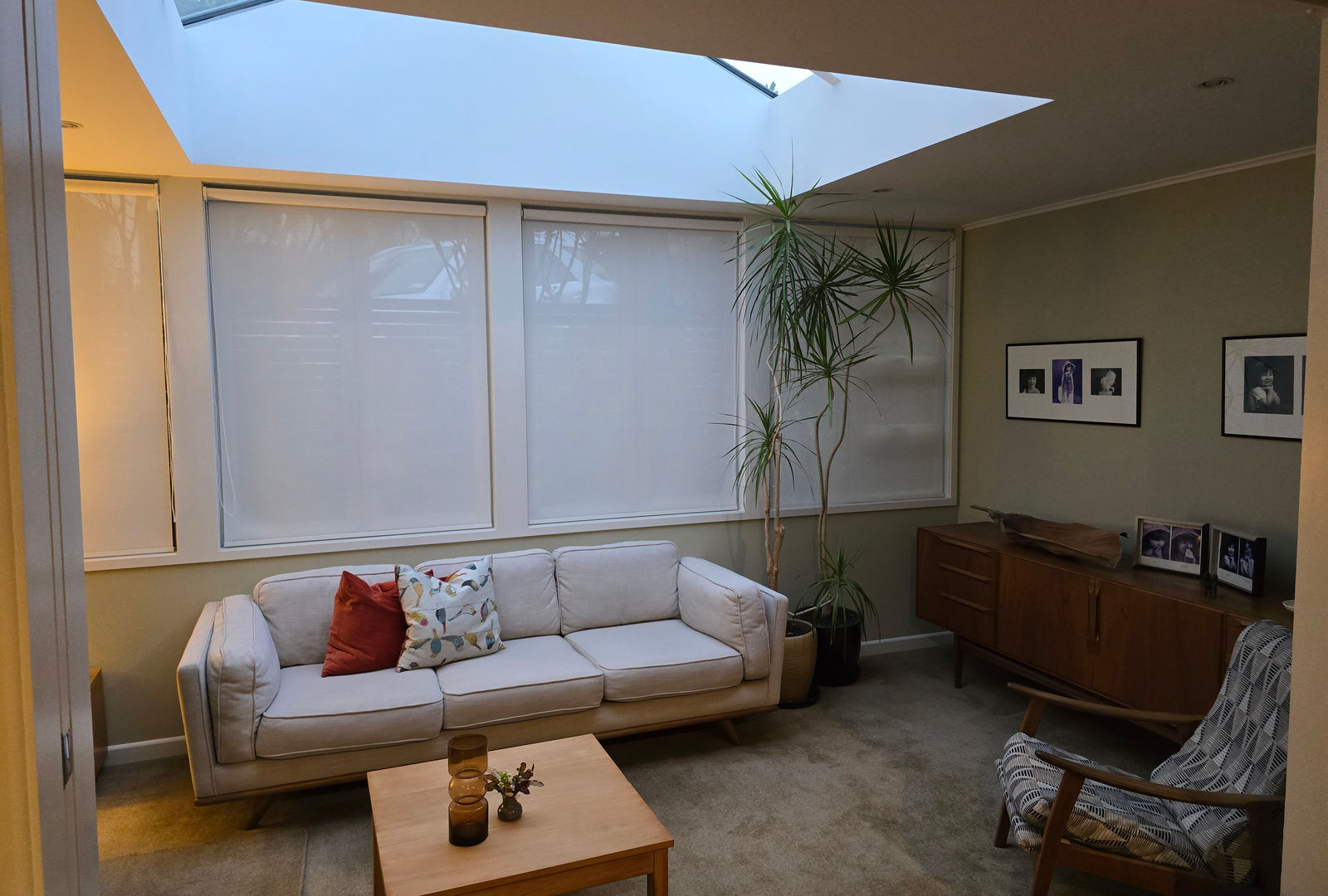
Wellington's slice of mid-century and new-build homes love a skylight and an angled clerestory window. Both look great and both let in more heat than most people plan for.
For skylights we run tensioned honeycomb blinds on a side-track system — the blind holds its position at any angle and doesn't flap. For angled tops (raked ceilings, gable-end windows), custom-cut roller blinds with a fixed rake track give you a clean horizontal edge that still pulls up and down normally.
The southerly is the design brief for outdoors
Any covering that lives on the outside of a Wellington house has to survive genuine wind. Standard outdoor roll-down screens are fine on a Nelson bach — not here. What works is Zipscreen: the fabric runs in a track either side, so wind loads through the mesh instead of lifting the blind off. Wind-rated up to 6m wide, motorised, with an optional wind sensor that retracts the blind automatically when a gust hits threshold.
On south-facing decks that catch the worst of it, aluminium exterior shutters are the belt-and-braces answer — they fold flat when the weather cooperates and act as a proper windbreak when it doesn't.
Warmth without a full renovation
A lot of Wellington's older housing stock won't get double-glazed any time soon. Window coverings are the cheapest thermal upgrade you can make. In order of impact, roughly:
- Blockout honeycomb blind with side channels — best value for cold bedrooms.
- Lined curtains with a pelmet or return, floor-length, closing the top of the window.
- Interior plantation shutters — surprisingly good insulation from the timber slats and closed frame.
- Sheer + curtain layering — most flexible for living rooms where you want day light and evening warmth.
None of this is exotic. But it's the difference between a room you actually want to sit in on a July evening and one you don't.
Want us to look at your rooms and tell you what would work? Book a free in-home consult.